
When I decided to build a website for the first time, I thought choosing a domain name would be one of the easiest parts. I already had an idea for the website, knew roughly what topic I wanted to cover, and assumed I could simply find an available name and register it.
I was wrong.
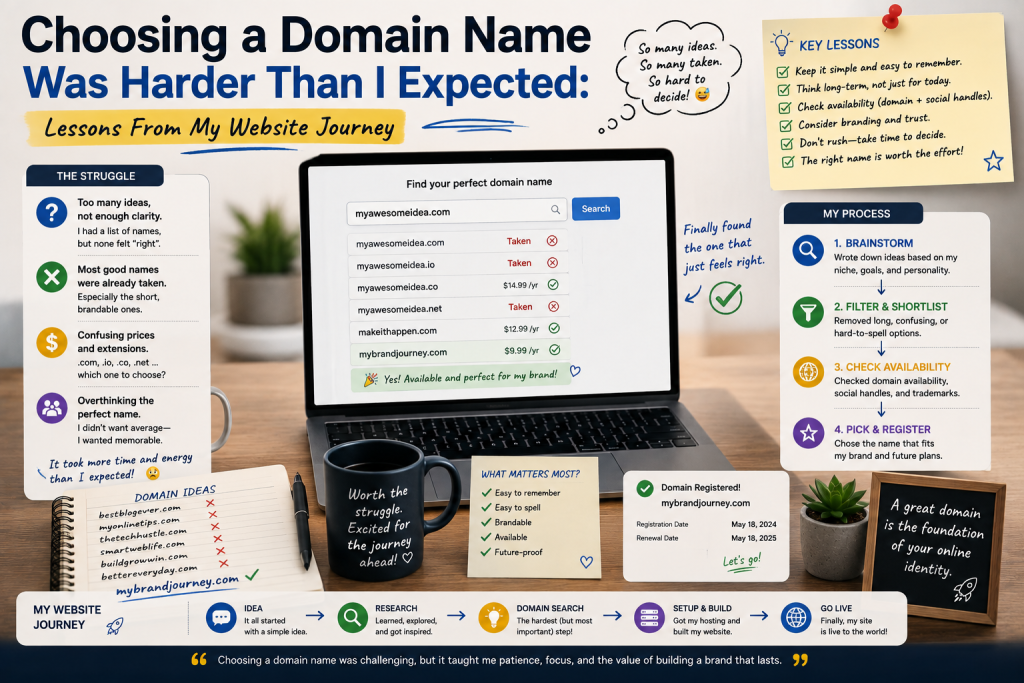
Choosing a domain name became one of the most surprisingly difficult parts of my website journey. What looked like a simple decision turned into a process involving branding, memorability, spelling, future plans, availability, and practicality.
Looking back, the experience taught me several lessons that I would definitely apply to my next website.
My First Ideas Were Already Taken
The process started with a list of names I liked.
I wanted something short, descriptive, and easy to remember. Unfortunately, many of my first choices were already registered.
This happened repeatedly.
I would think I had found the perfect name, check its availability, and discover that someone else had already claimed it.
At first, this was frustrating.
Eventually, I realized that an unavailable domain was not necessarily a problem. It simply meant I needed to think more creatively.
I started experimenting with different combinations of words and considered alternative names that still communicated the website’s purpose.
Short Does Not Always Mean Better
I initially believed that the shortest possible domain was automatically the best.
My thinking changed after testing different names.
A very short domain can be memorable, but it may not tell visitors anything about the website.
Meanwhile, a slightly longer name can sometimes be easier to understand.
I started looking for a balance between length and meaning.
The goal was not to create the shortest possible address.
The goal was to create an address that people could remember and type without unnecessary difficulty.
Spelling Matters More Than I Expected
Another lesson was the importance of spelling.
A domain might look clever on paper but become confusing when spoken aloud.
I began asking myself whether someone could hear the domain once and type it correctly later.
If a name required repeated explanations about spelling, I considered that a warning sign.
Simple spelling can be a significant advantage, especially when people discover a website through conversations, recommendations, or offline marketing.
I Started Thinking About the Future
One of my biggest mistakes would have been choosing a domain that was too narrow.
At the beginning, I had a very specific idea for my website.
But websites can evolve.
A project that starts with one topic may eventually cover related subjects, offer new services, or target a broader audience.
I therefore started asking a different question:
“Will this domain still make sense if my website changes in the future?”
That question helped eliminate several names that initially seemed attractive.
The Extension Was Another Consideration
I also had to think about the domain extension.
There are many options available today, but I wanted an extension that made sense for the website and would be easy for visitors to remember.
The familiar “.com” extension remained attractive because many people automatically associate it with websites.
However, depending on the project’s audience and purpose, other extensions can also make sense.
The important thing was choosing intentionally rather than simply selecting an extension because it happened to be available.
I Avoided Making the Name Too Complicated
At one point, I considered using a domain containing several words because the shorter alternatives were unavailable.
It technically worked, but it did not feel right.
Long names can be difficult to type and easier to mistype.
I also became cautious about unnecessary hyphens and unusual combinations of numbers and letters.
There are situations where these choices may be appropriate, but for my project I preferred simplicity.
Branding Changed My Perspective
Another important realization was that a domain is part of a brand.
Before this project, I mostly thought of a domain as an address.
Now I understand that visitors may associate the domain with the website’s identity.
A good domain can look professional on a business card, email address, social media profile, and search result.
That made me think about how the name would look and sound beyond the browser address bar.
I Checked for Potential Confusion
Before committing to a name, I also considered whether it could be confused with another website or brand.
A domain may be technically available but still create confusion if it is very similar to an established name.
This taught me that domain availability is not the only thing that matters.
Website owners should also think about branding and potential conflicts before building an identity around a particular name.
I Wish I Had Made a Shortlist
Looking back, I spent too much time trying to find one perfect name.
A better approach would have been to create a shortlist of perhaps five to ten strong candidates.
Then I could compare them based on:
- Memorability
- Spelling
- Relevance
- Length
- Brand potential
- Future flexibility
- Domain extension
- Potential confusion
This would have made the decision more objective.
The Perfect Name Does Not Really Exist
Perhaps the most important lesson was accepting that no domain name is perfect.
Every available option involves some compromise.
One might be memorable but slightly longer.
Another might be short but less descriptive.
Another might be highly relevant but too restrictive for future expansion.
Instead of searching endlessly for perfection, I learned to look for the best practical option.