
When I started building websites, one of my biggest questions was simple: Do I really need premium web hosting, or is a cheap hosting plan enough?
At first, the answer seemed obvious.
Why spend more money when a low-cost hosting plan can put a website online?
That was my thinking when I started. I wanted to keep expenses low, especially because I was still experimenting with different website ideas. After using both budget-oriented and more advanced hosting environments, however, my opinion became more nuanced.
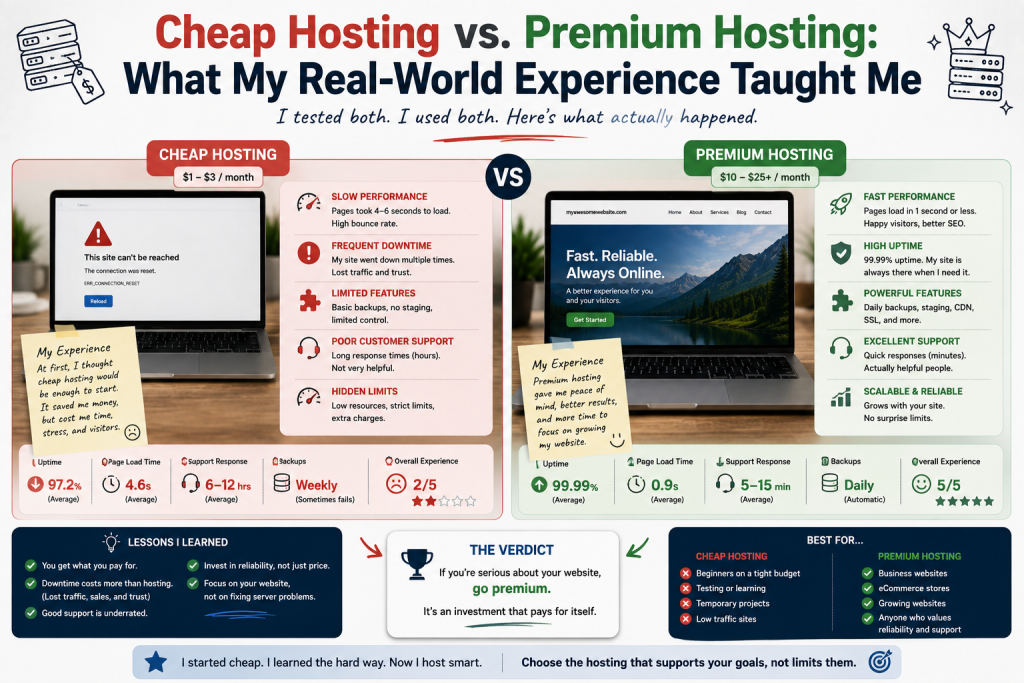
I learned that cheap hosting is not automatically bad, and premium hosting is not automatically better for everyone. The right choice depends on what a website actually needs.
Why Cheap Hosting Was Attractive
The main advantage of inexpensive hosting was obvious: affordability.
When launching a new website, keeping initial expenses under control can be important.
A basic hosting plan can provide enough resources for a personal blog, small informational website, portfolio, or early-stage project.
I appreciated being able to start without committing to a large monthly expense.
For a website with relatively low traffic and simple requirements, a budget plan can make perfect sense.
The problem began when I expected a low-cost plan to provide the same experience as a more powerful hosting environment.
Performance Made the Difference
One of the first differences I noticed was performance.
A website does not necessarily need expensive hosting to load quickly. Optimization, caching, image sizes, software configuration, and many other factors also matter.
However, hosting resources can still influence how a website behaves, especially as traffic and website complexity increase.
When a site began demanding more resources, the limitations of a basic environment became more noticeable.
That taught me an important lesson: hosting performance should be evaluated in the context of the entire website, not just the hosting price.
Resource Limits Can Become Important
Budget hosting plans often come with resource limits.
These may involve storage, CPU usage, memory, databases, simultaneous processes, or other restrictions, depending on the provider and plan.
For a small website, these limits may never become an issue.
As a website grows, however, they can become more relevant.
I learned to monitor resource usage rather than assuming that a hosting package would always be sufficient.
This also helped me recognize when an upgrade was actually justified.
Premium Hosting Offered More Headroom
The biggest advantage I noticed with more advanced hosting was additional headroom.
When a website needs more resources, having room to handle traffic increases can reduce the need for immediate changes.
Premium-oriented plans may also offer additional management tools, stronger support options, automated backups, enhanced security features, or more flexible infrastructure, depending on the provider.
These benefits can be valuable for businesses where website reliability is directly connected to revenue.
But they come at a cost.
Support Became More Valuable Than I Expected
One of the biggest differences between hosting experiences was not necessarily server speed.
It was support.
When everything works, support does not seem important.
When something breaks, it can suddenly become one of the most valuable services a hosting company provides.
As a beginner, I sometimes spent hours trying to understand technical problems.
Better documentation or responsive support could significantly reduce that frustration.
This changed the way I evaluate hosting.
I no longer look only at specifications.
I also consider how easy it will be to get help when something unexpected happens.
Backups Are Worth Paying Attention To
My experience also changed how I think about backups.
Some hosting plans provide automated backup functionality, while others may offer limited backup options or require additional configuration.
Regardless of the hosting tier, I learned that website owners should understand exactly what is being backed up and how restoration works.
Paying more for hosting does not remove the need for responsible backup practices.
I prefer having independent copies of important website data rather than relying entirely on one system.
Security Is Part of the Value
Premium hosting environments may offer additional security features, but security is never something that should be delegated completely to the hosting provider.
Strong passwords, account protection, software updates, secure configurations, and careful plugin management still matter.
The hosting environment can provide useful security tools, but the website owner also has responsibilities.
This was one of the biggest lessons from my experience.
When Cheap Hosting Makes Sense
After trying different options, I would not discourage anyone from choosing affordable hosting.
Budget hosting can be a sensible starting point when:
- The website is small.
- Traffic is relatively low.
- The software requirements are simple.
- The owner wants to minimize initial costs.
- There is a clear upgrade path if the site grows.
There is no reason to pay for resources you do not need.
When Premium Hosting Makes More Sense
A more expensive hosting environment may become worthwhile when:
- The website receives significant traffic.
- Performance is particularly important.
- The business depends heavily on online availability.
- More server resources are required.
- Advanced support is valuable.
- The website needs specialized configurations.
- Growth is expected.
The key is not choosing premium hosting simply because it sounds better.
The investment should solve a real problem.
The Hidden Cost of Cheap Hosting
The most interesting lesson was that the lowest monthly price is not always the lowest overall cost.
If a cheap hosting plan creates frequent technical problems, performance limitations, or time-consuming maintenance, the money saved may not compensate for the extra effort.
Time has value too.
At the same time, paying for premium hosting that provides features you never use can also be wasteful.
The goal is balance.