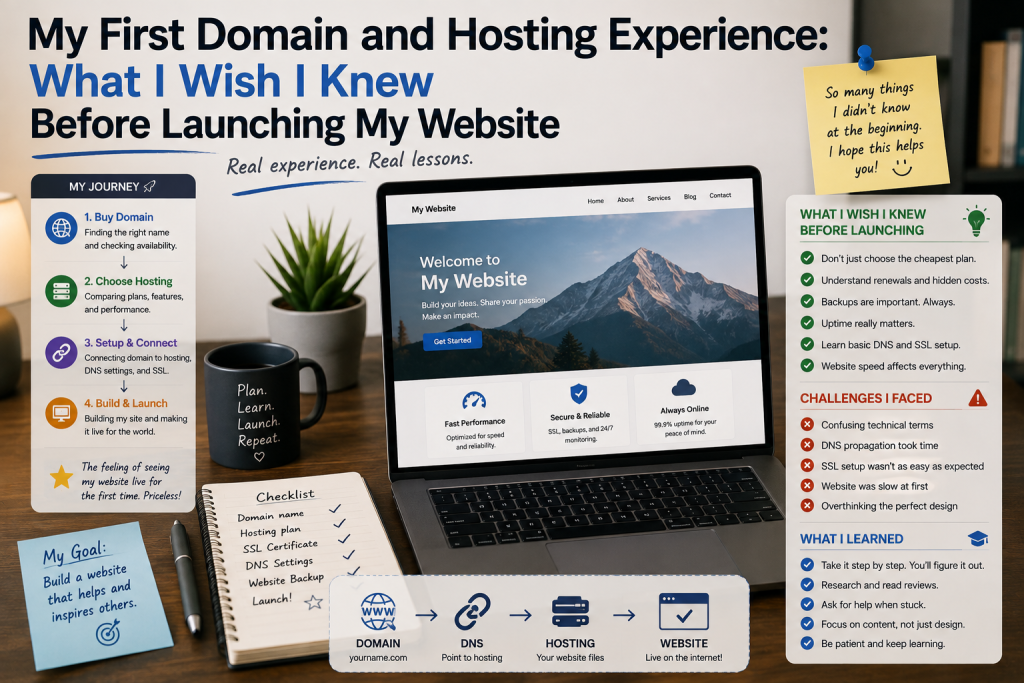

Launching my first website felt like a much bigger achievement than I expected. I had spent time thinking about the website’s purpose, choosing a design, and preparing the initial content. But before visitors could see any of it, I had to deal with two things that initially seemed confusing: a domain name and web hosting.
At first, I assumed buying a domain and hosting would be a simple process. In reality, I learned several valuable lessons about website ownership, configuration, security, performance, and long-term planning.
If I could go back to the beginning, there are several things I would definitely do differently.
Choosing a Domain Was More Difficult Than Expected
The first challenge was choosing the domain name.
I initially focused on finding something short and memorable. That seemed simple until I started checking availability.
Many of the names I liked were already registered.
I eventually realized that a good domain is not only about being short. It should also be easy to spell, easy to remember, and relevant to the website.
I also learned to think about the future.
A name that perfectly describes one small project might become restrictive if the website eventually expands into other topics or services.
That was one of my first major lessons: choose a domain with enough flexibility for your future plans.
I Did Not Understand Domain Registration at First
When I first registered my domain, I did not fully understand the difference between the domain itself and the services connected to it.
The domain is essentially the address people use to reach a website. Hosting, on the other hand, provides the server resources where the website’s files and data are stored.
Understanding this distinction made later configuration much easier.
It also helped me understand why changing hosting does not necessarily mean losing the domain.
Choosing Hosting Based Only on Price Was a Mistake
My first instinct was to look for the cheapest hosting plan.
After all, I was launching a new website and did not expect much traffic.
That seemed reasonable at the time.
However, I soon learned that price is only one part of the decision.
Storage, bandwidth, server performance, backups, security features, technical support, control panels, and upgrade options can all affect the experience.
The cheapest plan may be perfectly suitable for a small website, but it is important to understand exactly what is included.
Setup Took More Patience Than I Expected
Connecting the domain to the hosting account was another learning experience.
There were DNS settings, nameservers, account credentials, and other technical details that I had not previously considered.
At first, these terms looked intimidating.
Once I understood their basic purpose, the process became much less mysterious.
I learned that DNS changes may also take some time to become visible across the internet.
The important thing was not to panic when everything did not appear to work immediately.
Security Should Have Been a Priority From Day One
One of my biggest regrets was not thinking enough about security at the beginning.
A website is an online asset, and protecting it should be part of the initial setup rather than something added later.
I learned to pay attention to strong passwords, account protection, software updates, SSL/HTTPS, user permissions, and regular backups.
I also became more careful about installing unnecessary plugins or scripts.
Every additional component can introduce another potential source of problems.
Backups Became One of My Golden Rules
My first website taught me that backups are not optional.
Even if a hosting company provides backup services, I learned that maintaining an independent copy of important website data is a smart precaution.
A website can experience software problems, configuration mistakes, accidental deletions, or other unexpected issues.
Knowing that a recent backup exists provides considerable peace of mind.
Website Performance Matters
Initially, I was more concerned about how my website looked than how quickly it loaded.
That changed after I experienced slower pages.
Visitors do not necessarily care how complicated the technology behind a website is. They simply want pages to load and work properly.
I started paying more attention to image sizes, unnecessary scripts, plugins, caching, and hosting performance.
This taught me that website design and website performance need to be considered together.
Technical Support Can Make a Big Difference
Another lesson was the value of reliable hosting support.
When you are new to domains and hosting, even a relatively simple problem can feel complicated.
Clear documentation and responsive support can save hours of frustration.
I learned that hosting should not be evaluated only by server specifications.
The quality of support can be just as important, especially for website owners without extensive technical experience.
I Wish I Had Planned for Growth
When launching my first website, I only thought about what I needed at that moment.
I did not think enough about what might happen if the website became successful.
Today, I would consider whether the hosting provider offers easy upgrades, whether the domain can be managed conveniently, and whether the platform can accommodate increased traffic.
Planning for growth does not mean buying the most expensive plan immediately.
It means choosing an environment where growth is possible.
My Biggest Lesson
After going through the process, I realized that launching a website is not just about publishing pages.
A successful website requires a foundation.
The domain needs to be appropriate and manageable. Hosting needs to be reliable enough for the project’s requirements. Security and backups need attention, and performance should not be ignored.
Most importantly, website owners should understand the basic technology behind their online presence.
You do not need to become a server administrator.
But knowing what your domain, hosting, DNS, SSL certificate, backups, and account settings do can make website management much less stressful.