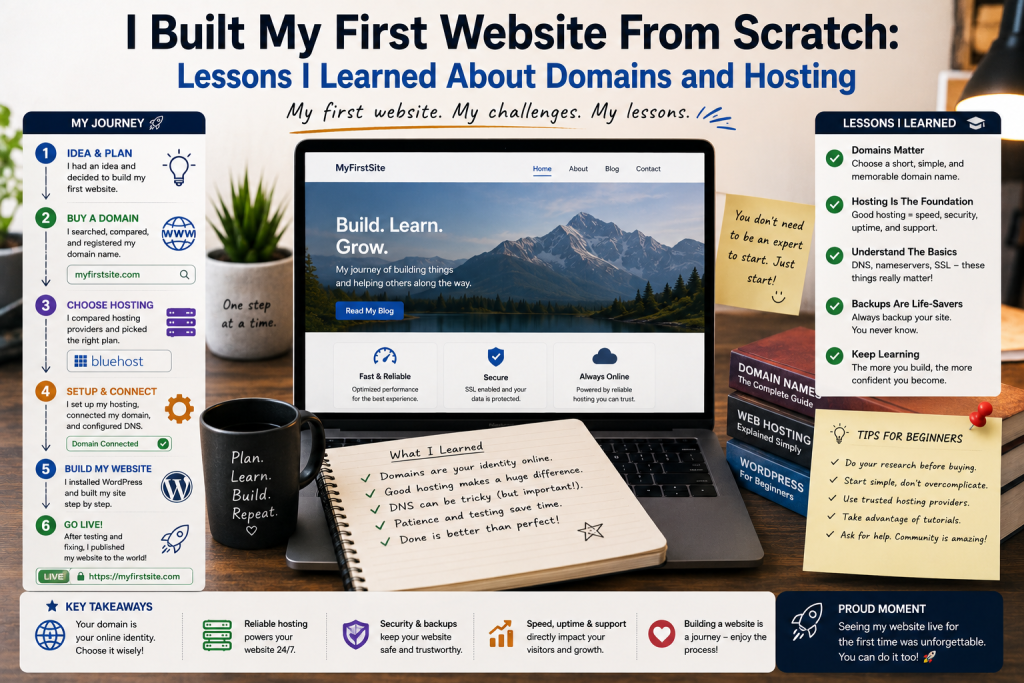

Building my first website from scratch was one of those projects that looked easy from the outside but became much more educational once I actually started doing it.
Before beginning, I thought the process was mostly about creating pages, adding content, choosing a design, and publishing everything online. I did not realize how important domains and hosting would become.
The website itself was only one part of the project. I also had to understand where the website would live, how visitors would find it, how files would be managed, and what could go wrong after launch.
Looking back, the experience taught me several lessons that I wish I had known from the beginning.
The Idea Came Before the Technology
Before purchasing anything, I started with the purpose of the website.
I wanted to know what kind of information I would publish, who might visit the site, and what I wanted visitors to accomplish.
This turned out to be important because technology decisions became easier once the purpose was clear.
A simple informational website has different requirements from an online store, a community platform, or a website with a large database.
My first mistake would have been choosing hosting before understanding what I actually needed.
Choosing a Domain Was Surprisingly Difficult
The next step was choosing a domain name.
I had several ideas, but many were already unavailable.
I quickly learned that finding an available domain is not the same as finding a good domain.
I wanted something easy to remember, simple to type, and relevant to the website.
I also considered whether the name would still make sense if the website expanded in the future.
That was an important lesson: a domain should not only describe what your website is today; it should leave room for what it could become tomorrow.
I Learned the Difference Between Domain and Hosting
Before building the site, I had to understand two basic concepts.
The domain is the address people use to access the website.
Hosting provides the server environment where the website’s files, databases, and other resources are stored.
At first, these concepts seemed connected in a confusing way.
Eventually, I started thinking of the domain as an address and hosting as the place where the website lives.
That simple analogy made the rest of the setup much easier to understand.
My First Hosting Decision Was Based Too Much on Price
When comparing hosting plans, price immediately caught my attention.
I assumed that a cheaper plan would be the obvious choice for a new website.
After looking more carefully, I realized that hosting plans differ in important ways.
Storage, server resources, backups, security features, databases, support, and upgrade options can all affect the experience.
I eventually focused less on finding the cheapest plan and more on finding one that matched the website’s actual requirements.
Setting Up DNS Was a Learning Experience
Connecting the domain to the hosting account was probably one of the most technical parts of my first project.
I encountered DNS records, nameservers, and other configuration terms that were completely unfamiliar.
At first, I was nervous about changing anything.
After learning what the settings were designed to do, the process became less intimidating.
I also learned an important lesson about patience.
DNS changes do not necessarily become visible everywhere instantly. When something appears not to work immediately, it is important to verify the configuration and allow time for changes to propagate.
Building the Website Was the Fun Part
Once the domain and hosting were connected, I could focus on the website itself.
I created the basic structure, added content, organized navigation, and worked on the design.
This was the part I had originally imagined when I thought about building a website.
But I soon realized that a website is not finished simply because it looks good.
It also needs to be functional, secure, accessible, and reasonably fast.
Security Became a Priority
One of the biggest lessons was that security should be considered from the beginning.
I learned to use strong account credentials, keep software updated, limit unnecessary access, and use HTTPS where appropriate.
I also became more careful about installing plugins, themes, scripts, or other components that were not essential.
Every additional component can introduce potential maintenance or security concerns.
Backups Gave Me Peace of Mind
Another lesson was the importance of backups.
Before starting the project, I underestimated how valuable a backup could be.
Once I had spent hours creating content and configuring the website, the idea of losing everything became much more concerning.
I learned to maintain backups of important website files and databases rather than assuming that nothing would ever go wrong.
Having a recovery option makes experimenting much less stressful.
Performance Matters More Than Appearance
Initially, I spent more time thinking about colors, layouts, and images than loading speed.
That changed when I started testing the website.
Large images, unnecessary scripts, excessive plugins, and poorly optimized resources can make pages slower.
I learned that a successful website needs a balance between visual appeal and performance.
Visitors generally care about whether a page loads quickly and works properly more than how complicated the technology behind it is.
I Wish I Had Planned for Growth
My first website was designed around what I needed at the beginning.
I did not think much about what would happen if the site became popular.
Today, I would think more carefully about future hosting upgrades, backups, database requirements, traffic increases, and the possibility of moving the website later.
Planning for growth does not mean spending unnecessarily from the start.
It means making choices that do not create avoidable limitations.